
Panama City / Research guide
Research a house in Panama before a viewing
Check the advertised property, entrance and area definition, then turn unresolved map questions into a focused viewing checklist.
Before viewing a house in Panama, establish which property is being advertised, where its entrance is and what the stated area measures. A map review can reveal questions worth asking. It cannot verify the interior, establish ownership or prove that a listing describes the selected building.
Separate the listing from your observations
Save the advertisement, its observation date, asking price in the original currency, address and area description. Keep the advertiser's statements separate from facts you have checked. A facade photograph, an approximate pin and a square-metre figure may each concern different parts of the property.
Search the Panama map using the city and district or sector as well as the street information. Inspect the suggestion before choosing it. Zoom in to compare neighbouring junctions and the expected entrance. A search marker can represent a road position or landmark rather than the house itself.
Selecting an outline is a further identification step. If the outline does not fit the information provided, retain the uncertainty and ask for a more precise location before assuming the nearest building is correct.
A building record is not automatically a house
The P.H. Macabi record in El Cangrejo illustrates the distinction. Checked on September 22, 2026, it showed a 534.21 m² footprint, with no matched parcel and no unit area. Its source attributes classify the building as apartments. The figure describes the building outline, not one apartment or an individual house.
Panama's pricing coverage checked for this guide supported houses for sale in USD. It did not provide an enabled apartment cohort. Applying house observations to an apartment in this building would therefore be an unsupported substitution, even though building exploration itself is available.
Make the visit answer specific questions
Confirm the part of the property included in the advertisement and the actual entrance. Ask for land and construction areas to be identified separately. If a single total is supplied, clarify its components before comparing it with another home.
During the visit, observe daylight, ventilation, noise and visible condition. Note the time and distinguish a personal observation from a technical assessment. Recent internal alterations and room conditions cannot be read from a roof outline.
For institutional geographic context, inspect the IGN Tommy Guardia digital cartography information. Its purpose and scale should be checked independently of the listing.
Compare only what you have identified
Keep unresolved location, type or area questions visible. A broad asking-price reference can provide context without establishing the value of the house you visit. Continue with reading a price reference, area definitions and the Panama hub. The methodology supplies common concepts while preserving the Colombian model's own scope.
Watch the walkthrough
Silent video with captions. Press play to load the recording.
Watch page and full transcript →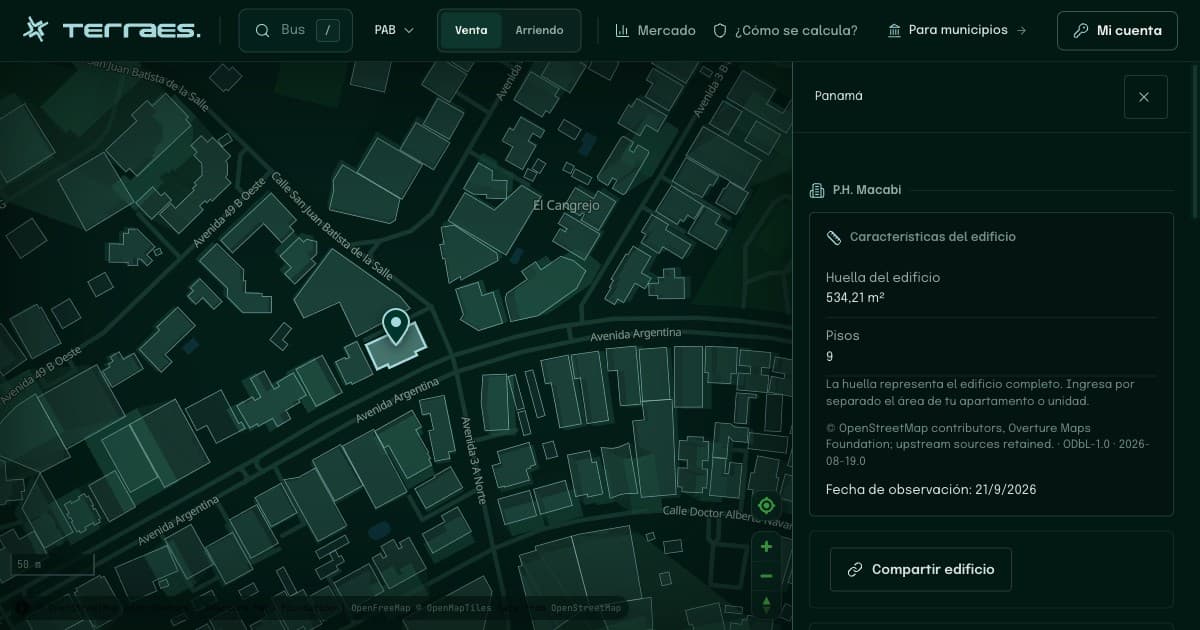
Continue your research
How to read a house asking-price reference in Panama
Check property type, sale coverage and geographic scope before treating a price reference as evidence about a particular house.
Read guide →02 · PanamaBuilding footprint, land and apartment area in Panama
Understand why an El Cangrejo building outline cannot establish the size of an apartment inside it.
Read guide →Sources and review
By Terraes editorial team · Published · Updated
- Overture Maps Foundation — Buildings · accessed 2026-09-22
- Instituto Geográfico Nacional Tommy Guardia — Cartografía digital · accessed 2026-09-22
Mapped footprints do not establish legal ownership or apartment floor area. Advertisements describe asking prices; area references are neither recorded sale prices nor official appraisals.