
Panama City / Research guide
Building footprint, land and apartment area in Panama
Understand why an El Cangrejo building outline cannot establish the size of an apartment inside it.
A building footprint in Panama does not tell you the size of an apartment inside it. Land, the horizontal outline of a structure and an individual unit require different evidence. This matters when a map displays a tower but the advertisement concerns just one home.
Read the available fields before calculating
The P.H. Macabi record in El Cangrejo showed a 534.21 m² footprint when checked on September 22, 2026. Unit area and a matched parcel were unavailable. The record came from Overture release 2026-08-19.0 and retained source attributes and OpenStreetMap attribution.
Even where a record includes a floor count, it does not disclose the number of apartments, their layouts or their individual areas. Multiplying a footprint by storeys assumes equivalent floor plates and an agreed treatment of every space. Dividing that result by an assumed apartment count introduces another unsupported step.
Keep unit area unknown until a source identifies that particular unit. A blank field is more informative than an arithmetic result that resembles a measurement but rests on unverified assumptions.
Match the measurement to your task
A footprint can help recognise a structure on a map. Researching an advertised apartment requires that unit's area and an explanation of what it includes. Researching land requires the corresponding parcel identity and geometry; the building outline does not automatically provide plot boundaries.
For a house, the same caution applies. A horizontal outline need not equal the total construction area. Levels and other components may require information that an overhead view cannot supply. Where a listing distinguishes land and construction, preserve the distinction in your notes.
Compare consistent definitions
Ask what the advertised area includes and retain the answer with its source. Check how open spaces, parking or shared areas are treated before dividing price by a total. Do not silently modify one listing's definition to make it comparable with another.
If two figures concern the same unit, compare their dates and definitions before deciding one is wrong. The disagreement may expose different measurements or an unresolved unit identity. Institutional maps provide a different type of context: review the purpose of IGN Tommy Guardia cartography before treating it as evidence about advertised apartment areas.
An area figure does not create pricing coverage
The Panama pricing cohort checked for this guide supported houses for sale in USD, not apartments. Finding a verified apartment area would not by itself remove that separate limitation. P.H. Macabi remains useful for building exploration without receiving a house-based estimate.
Continue with preparing a house viewing, reading a price reference or the Panama hub. The methodology introduces shared concepts while keeping the Colombian model within its stated scope.
Watch the walkthrough
Silent video with captions. Press play to load the recording.
Watch page and full transcript →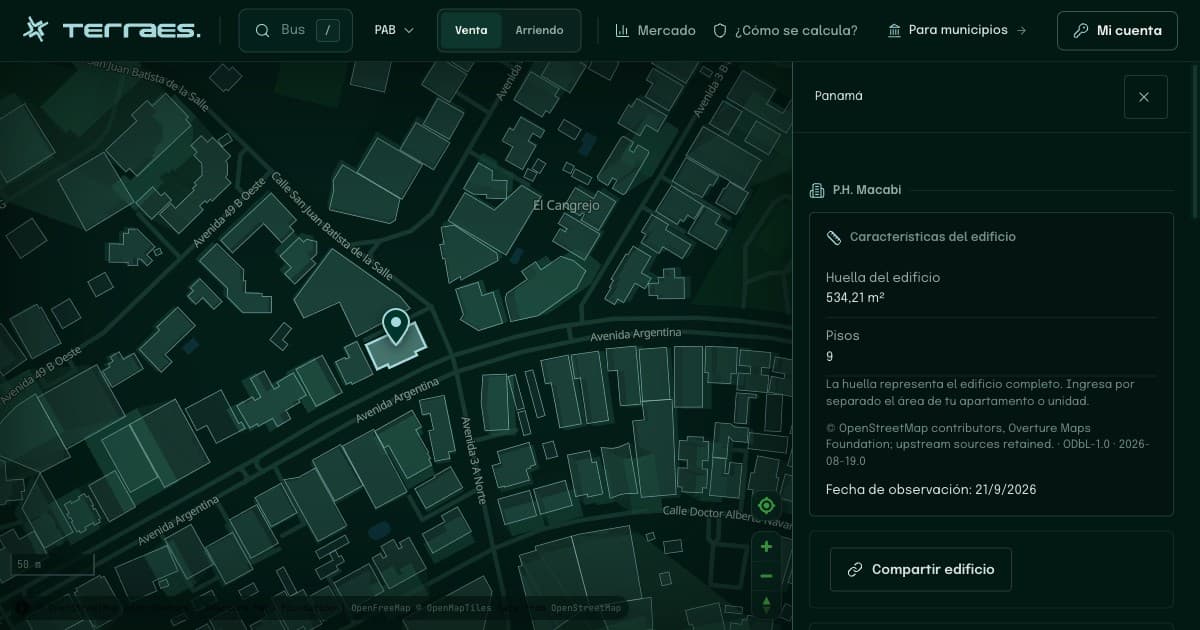
Continue your research
How to read a house asking-price reference in Panama
Check property type, sale coverage and geographic scope before treating a price reference as evidence about a particular house.
Read guide →02 · PanamaResearch a house in Panama before a viewing
Check the advertised property, entrance and area definition, then turn unresolved map questions into a focused viewing checklist.
Read guide →Sources and review
By Terraes editorial team · Published · Updated
- Overture Maps Foundation — Buildings · accessed 2026-09-22
- Instituto Geográfico Nacional Tommy Guardia — Cartografía digital · accessed 2026-09-22
Mapped footprints do not establish legal ownership or apartment floor area. Advertisements describe asking prices; area references are neither recorded sale prices nor official appraisals.