
Guatemala City / Research guide
Research a Guatemala City neighbourhood before a viewing
Turn a zona search into a practical investigation of the address, access and questions that require an on-site visit.
Start neighbourhood research in Guatemala City by defining the streets, entrances and journeys that matter to you. A zona name is not a complete description of every block or home within it. The useful output of a map review is a set of questions you can verify during a viewing.
Replace broad labels with specific observations
Open the Guatemala map and locate the address with its municipality and zona intact. Identify the block and the roads from which you would approach it. Instead of writing “convenient location”, record the entrance you expect to use and the particular destination you need to reach.
Keep map observations separate from assumptions about daily life. A nearby road does not establish where the building entrance is, how easy a crossing will be or the journey time at your usual departure hour. A business label does not verify current opening hours or the suitability of that service for your needs.
A simple note can contain three columns: visible on the map, reported by someone else, and still to check. This makes uncertainty useful rather than allowing a polished map to hide it.
Use a landmark for orientation only
The Holiday Inn building record in zona 10 is a practical orientation example. Checked on September 22, 2026, it showed a footprint of 1,831.58 m², with no matched parcel and no individual unit area.
The identifiable outline helps locate a particular structure. It does not establish residential prices, personal safety or the quality of nearby housing. Nor does a hotel become a house comparable through proximity. Keep the spatial reference distinct from any market comparison you perform later.
Plan a viewing that fills the actual gaps
Approach from the street you would normally use and verify the entrance. Walk the relevant route where practical, noting the time of the observation. At the home itself, inspect daylight, orientation, noise and the relationship to neighbouring buildings. An overhead footprint cannot establish these interior conditions.
If comparing two homes, use equivalent questions for both. Different visiting times can explain contrasting impressions more plausibly than a broad neighbourhood label. Preserve unresolved facts such as an approximate address or an entrance that has not yet been checked.
Avoid conclusions about residents based on map geometry. Institutional geographic information is another evidence category: use the official-source guide to check which geography and date a product covers. It should not be confused with an account of lived experience.
Keep price claims geographically honest
A wider-area price reference does not establish the asking price on one street. Check original currency, property type, transaction and location precision using comparable quality. Return to the Guatemala hub for the remaining workflow. The methodology provides shared concepts, with no assumption that its Colombian estimator covers Guatemala.
Watch the walkthrough
Silent video with captions. Press play to load the recording.
Watch page and full transcript →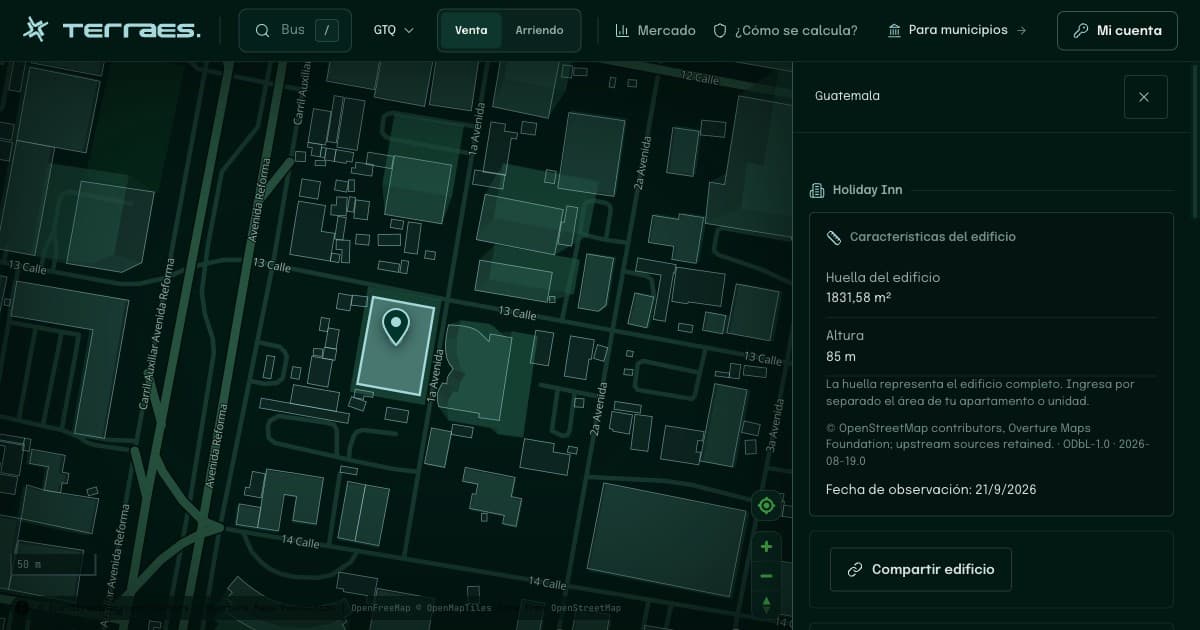
Continue your research
Check the quality of property comparables in Guatemala
Spot duplicate listings, uncertain locations and incompatible currencies or areas before relying on an asking-price reference.
Read guide →02 · GuatemalaFind a building by address in Guatemala City
Use the municipality and zona to locate an address, select the right building outline and understand the limits of the match.
Read guide →Sources and review
By Terraes editorial team · Published · Updated
- Overture Maps Foundation — Buildings · accessed 2026-09-22
- Registro de Información Catastral de Guatemala — Servicios catastrales · accessed 2026-09-22
Mapped footprints do not establish legal ownership or apartment floor area. Advertisements describe asking prices; area references are neither recorded sale prices nor official appraisals.