Lleva a la visita las preguntas que cambian tu decisión
Tienes dos apartamentos guardados. Uno cuesta menos; el otro parece mejor ubicado. Los anuncios muestran áreas distintas, las fotos no enseñan la misma cantidad de detalles y todavía no sabes cuánto se escucha desde la habitación.
Antes de coordinar las visitas, reúne una comparación que deje visibles lo que sabes, de dónde salió y lo que falta confirmar. Puedes hacerlo en tus investigaciones de Terraes y completar las preguntas con una nota propia. El objetivo es llegar a cada apartamento con asuntos concretos por resolver.
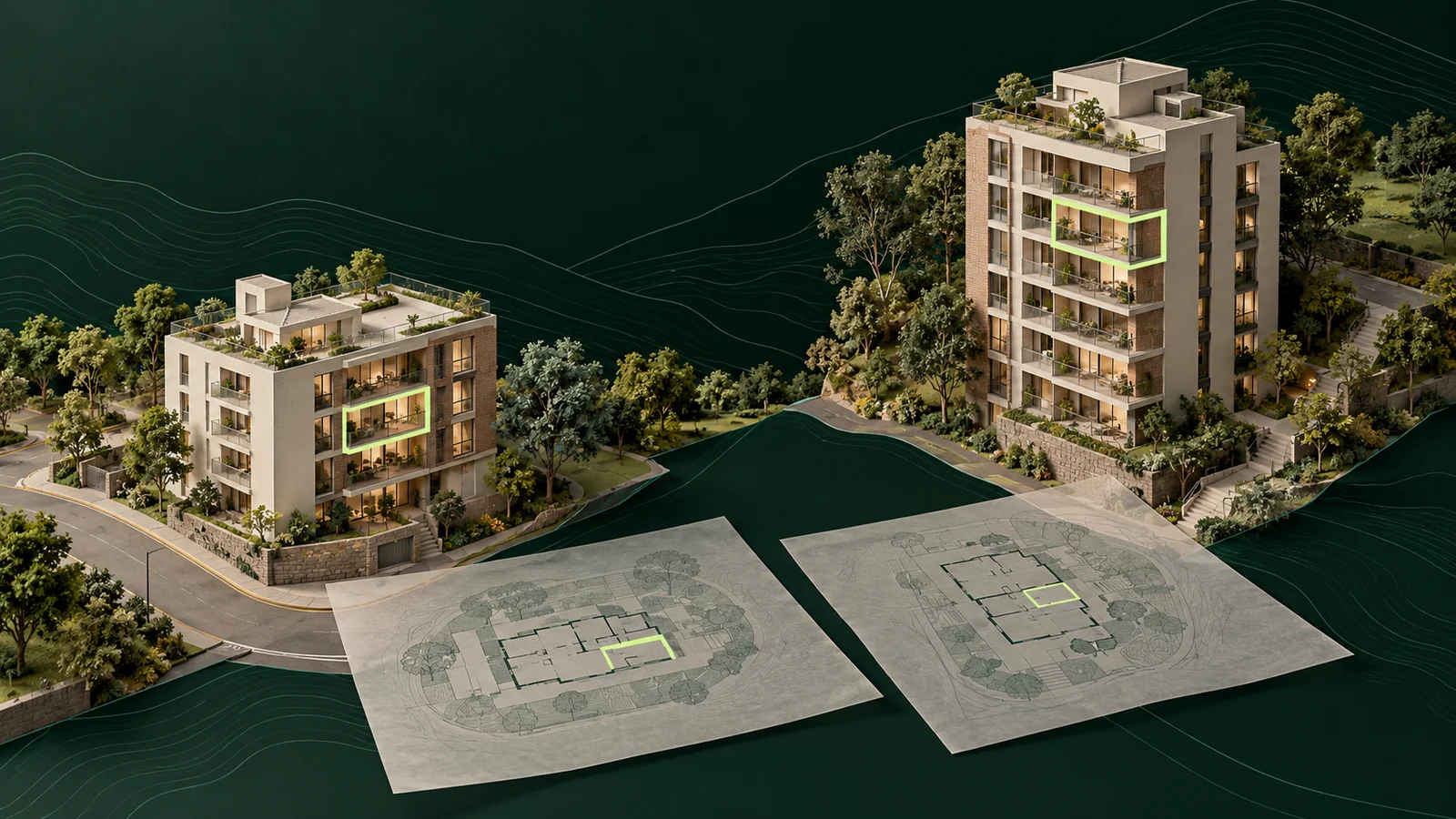
La portada es una ilustración conceptual de dos edificios ficticios; no muestra inmuebles en venta.
Empieza por la unidad, no por el precio
Busca la primera dirección en el mapa de Terraes y confirma que el edificio corresponda al anuncio. Anota el apartamento, piso y orientación que te indicaron. Repite con la segunda opción.
El mapa puede localizar un edificio sin identificar la unidad privada que te ofrecen. Si un dato describe el lote, la huella del edificio o la zona, conserva ese alcance. No lo conviertas en un dato del apartamento por estar junto a su dirección.
Antes de calcular un precio por metro cuadrado, pide que te aclaren qué área publica cada anuncio y con qué documento la respaldan. Si un anuncio usa área construida y el otro área privada, la división no produce una comparación equivalente. Tampoco uses la huella del edificio como superficie de la vivienda.
Compara la misma operación y conserva el precio completo
Separa venta de arriendo mensual, mantén la misma moneda y anota la fecha en que viste cada oferta. Especifica si el precio incluye parqueadero o cuarto útil. Cuando esa información no esté disponible, déjala como pregunta.
Guarda el precio total junto al valor por metro cuadrado. Este último ayuda a ordenar referencias comparables, pero pierde información sobre distribución, estado, piso y elementos incluidos. La guía de precio por metro cuadrado explica por qué importa el tipo de operación y de área.
Un ejemplo donde el anuncio más barato deja de ser tan claro
Los siguientes datos son ficticios. Sirven para practicar el método; no son ofertas, avalúos ni una recomendación de compra.
| Pregunta | Apartamento A | Apartamento B |
|---|---|---|
| Precio de venta anunciado | COP 480 millones | COP 510 millones |
| Área declarada | 80 m², tipo por confirmar | 85 m², tipo por confirmar |
| División inicial | COP 6 millones/m² | COP 6 millones/m² |
| Parqueadero | Inclusión por confirmar | El anuncio dice que está incluido |
| Administración mensual | COP 520.000, por verificar | COP 380.000, por verificar |
| Habitación principal | Orientación por confirmar | Orientación por confirmar |
Ambos anuncios arrojan la misma división inicial. Todavía falta comprobar que las áreas sean del mismo tipo y que los precios incluyan elementos equivalentes. Esa comprobación va antes de concluir que tienen el mismo precio por metro cuadrado.
La diferencia anunciada de administración es COP 140.000 al mes, o COP 1.680.000 en doce meses si las cuotas permanecen iguales. Es una cuenta parcial: faltan servicios, mantenimiento, posibles cuotas extraordinarias y los demás gastos que correspondan a tu caso. Conserva esos conceptos separados; la suma no es un costo total de propiedad ni una proyección de rentabilidad.
La siguiente acción útil es pedir soporte del área y de lo que incluye el precio. Así sabrás qué cifras puedes comparar cuando llegues a la visita.
Usa la evidencia para decidir qué preguntar
Al revisar una estimación en Terraes, conserva su fecha, los datos que ingresaste y el estado de la evidencia. Una referencia de zona y una estimación sustentada para un escenario tienen alcances distintos. Si no hay evidencia suficiente, la ausencia de resultado no vuelve barato o caro al inmueble.
Los comparables también necesitan contexto: operación, área, fecha y ubicación. Consulta qué demuestran los comparables inmobiliarios y la metodología de Terraes antes de usar una cifra para negociar.
En Medellín, el mapa de ruido añade una pregunta para la visita: ¿cómo se escucha esta unidad en los horarios en que la vas a usar? Terraes muestra contornos de AMVA de septiembre de 2022, modelados a 4 metros. El alcance de la capa está explicado en esa página. No describe el interior actual del apartamento ni permite deducir el ruido de un piso alto.
AMVA explica que sus mapas de ruido ambiental representan condiciones modeladas para periodos de día y noche. También advierte que los establecimientos de comercio no se reflejan en esos mapas. Para un apartamento junto a una zona comercial, esa ausencia es una razón concreta para visitar en el horario que te preocupa.
Guarda un escenario que puedas reconocer después
En la ficha, usa Guardar investigación. Con una cuenta puedes conservar el inmueble y los datos del escenario. Espera la confirmación «Guardado en tu cuenta» antes de pasar a la siguiente opción.
Si cambiaste un dato relevante, como el área, conserva el nuevo escenario con Guardar escenario. En tus investigaciones, añade una nota que explique qué cambió y qué falta verificar. Evita sobrescribir mentalmente la cifra anterior: una estimación con otra área responde a otra consulta.
Guarda la segunda opción y usa Comparar para revisar las investigaciones juntas. La comparación te ayuda a mantener visibles las diferencias; las preguntas sobre documentos, estado físico o costos deben resolverse con la fuente correspondiente.
Copia estas preguntas antes de salir
- Unidad y área. ¿Qué apartamento estamos visitando y qué documento respalda el tipo de área anunciado?
- Precio e incluidos. ¿El precio que anoté sigue vigente? ¿Qué incluye exactamente?
- Gastos. ¿Cuál es la administración actual? ¿Hay cuotas extraordinarias aprobadas o gastos pendientes por aclarar?
- Ruido. ¿Qué se escucha en la habitación con las ventanas abiertas y cerradas? ¿Hace falta otra visita en un horario distinto?
- Luz y ventilación. ¿Cómo entra la luz a los espacios que vas a usar? ¿Qué puedes observar y qué solo te están contando?
- Estado físico. ¿Hay manchas, reparaciones o equipos cuyo estado necesites revisar con un profesional?
- Recorrido cotidiano. ¿Cómo es la entrada peatonal, la pendiente y el trayecto que realmente harás?
- Pendiente decisivo. ¿Qué dato podría cambiar tu decisión y quién puede confirmarlo?
Después de cada visita, añade observaciones con fecha. Distingue lo que viste de lo que afirmó el anunciante y de lo que aparece en los documentos. Si una duda sigue abierta, déjala abierta también en tus notas.
Abre Terraes y organiza la primera investigación. Puedes consultar la cobertura por país antes de buscar fuera de Colombia; encontrar un edificio en el mapa no garantiza que existan referencias de precio para esa ubicación.
How to compare two apartments before visiting
You have saved two apartments. One costs less; the other seems better located. The listings show different areas, the photographs reveal different amounts of detail and you still do not know what you would hear from the bedroom.
Before arranging visits, build a comparison that keeps what you know, where it came from and what still needs checking visible. You can organise your saved research in Terraes and keep the remaining questions in your own notes. The aim is to arrive at each apartment with specific matters to resolve.
The cover is a conceptual illustration of two fictional buildings, not properties for sale.
Start with the unit, then look at the price
Find the first address on the Terraes map and confirm that the building matches the listing. Note the apartment, floor and orientation you were given. Repeat for the second option.
The map may locate a building without identifying the private unit being offered. If a figure describes the parcel, building footprint or surrounding area, preserve that scope. Its position beside an address does not turn it into an apartment-level fact.
Before calculating a price per square metre, ask what kind of area each listing uses and which document supports it. If one uses built area and the other private area, the divisions are not equivalent. Do not use a building footprint as the apartment's floor area either.
Match the transaction and keep the full asking price
Separate sales from monthly rentals, use the same currency and record when you saw each offer. Note whether parking or a storage room is included. If that information is missing, keep it as a question.
Retain the total asking price alongside the price per square metre. The latter helps organise comparable references, but leaves out information about layout, condition, floor and included items. Terraes's price-per-square-metre guide, in Spanish, explains why the transaction and area types matter.
An example where the cheaper listing needs a closer look
The following figures are fictional. They illustrate the method and are not listings, appraisals or a recommendation to buy.
| Question | Apartment A | Apartment B |
|---|---|---|
| Advertised sale price | COP 480 million | COP 510 million |
| Stated area | 80 m², type unconfirmed | 85 m², type unconfirmed |
| Initial division | COP 6 million/m² | COP 6 million/m² |
| Parking | Inclusion unconfirmed | Listing says it is included |
| Monthly building fee | COP 520,000, unverified | COP 380,000, unverified |
| Main bedroom | Orientation unconfirmed | Orientation unconfirmed |
Both listings produce the same initial division. You still need to check that the areas use the same definition and the prices include equivalent items. Do that before concluding that their prices per square metre match.
The stated building fees differ by COP 140,000 a month, or COP 1,680,000 over twelve months if the fees remain unchanged. This is a partial calculation: utilities, maintenance, possible special assessments and other expenses are still missing. Keep those items separate; the calculation is neither total ownership cost nor an investment return forecast.
The useful next action is to request supporting information for the area and what the price includes. You will then know which figures can be compared during the visit.
Let the evidence shape your questions
When reviewing a Terraes estimate, retain its date, your inputs and the evidence status. An area reference and an estimate supported for a particular scenario have different scopes. If evidence is insufficient, a missing result does not make the property cheap or expensive.
Comparables also need context: transaction type, area, date and location. Read what property comparables establish, in Spanish, and Terraes's methodology before using a number in a negotiation.
In Medellín, the noise map, in Spanish, adds a question for your visit: what does this particular unit sound like at the times you will use it? Terraes displays AMVA contours from September 2022, modelled at a height of 4 metres. That page explains the layer's scope. It does not describe current indoor noise or establish what a high-floor apartment sounds like.
AMVA explains that its environmental noise maps, in Spanish, represent modelled daytime and nighttime conditions. It also states that commercial establishments are not represented in these maps. For an apartment beside a commercial area, that omission gives you a specific reason to visit at the time that concerns you.
Save a scenario you can recognise later
Choose Save research in the property panel. An account lets you retain the property and scenario inputs. Wait for “Saved to your account” before moving to the next option.
If you change a relevant input, such as area, keep the new scenario with Save scenario. Add a note in your research explaining what changed and what remains unverified. An estimate using a different area answers a different query, so preserve that context.
Save the second option and use Compare to review the research together. The comparison keeps the differences visible; questions about documents, physical condition or costs still need to be resolved with the appropriate source.
Copy these questions before heading out
- Unit and area. Which apartment are we visiting, and what document supports the advertised area type?
- Price and included items. Is the price I recorded still current? What exactly does it include?
- Expenses. What is the current building fee? Are there approved special assessments or costs that need clarification?
- Noise. What can I hear in the bedroom with windows open and closed? Should I return at a different time?
- Light and ventilation. How does light enter the rooms I will use? What can I observe, and what am I only being told?
- Physical condition. Are there stains, repairs or equipment that need a professional inspection?
- Daily route. What are the pedestrian entrance, slope and actual journey I will make like?
- Decisive unknown. Which unanswered question could change my decision, and who can confirm it?
After each visit, add dated observations. Distinguish what you saw from what the advertiser said and what the documents establish. Keep unresolved questions visible in your notes.
Open Terraes and organise your first property research. Check the country coverage guide before looking outside Colombia; finding a building on the map does not guarantee that price references exist for its location.